Pearson Edexcel · GCSE · Psychology
Course version: 1PS0 · Version from Sept 2017
Understand conformity to majority influence and factors affecting…
Full specification wording
Social influence: 5.1.3 Understand conformity to majority influence and factors affecting conformity to majority influence, including: a. personality b. the situation
Conformity to majority influence occurs when an individual yields to group pressure, changing their behaviour to align with the majority.
Checked against the Pearson Edexcel 1PS0 specification (opens in a new tab) on .
- Point 3 of 6
Study notes
From the checked teaching notes for this specification point.
The idea
Conformity to majority influence occurs when an individual yields to group pressure, changing their behaviour to align with the majority. This is driven by the desire to fit in or the belief that the group is correct. Factors affecting conformity include personality and the situation. Personality factors, such as locus of control, play a role; individuals with an internal locus of control are less likely to conform because they rely on their own judgement. Situational factors include group size, task difficulty, and unanimity.
For example: If a student is in a group where everyone else agrees on a wrong answer, they are more likely to conform if the group is unanimous, but less likely to conform if one other person dissents.
What earns the marks
- Define conformity as yielding to group pressure to fit in or to be right.
- Identify personality factors, such as locus of control, that affect conformity levels.
- Explain how an internal locus of control reduces the likelihood of conformity.
- Identify situational factors, such as group size, unanimity, and task difficulty.
- Explain how a unanimous majority increases conformity, whereas the presence of a dissenter reduces it.
Common mistakes and how to put them right
Confusing conformity with obedience.
Put it right: Conformity is yielding to peer pressure, whereas obedience is following orders from an authority figure.
Assuming personality is the only factor.
Put it right: Both personality (e.g., locus of control) and situational factors (e.g., group size) interact to affect conformity.
Believing conformity always increases with group size.
Put it right: Conformity increases up to a point (usually around three to four people) but then levels off.
Exam tips
- When evaluating conformity, always consider both dispositional (personality) and situational factors to provide a balanced answer.
- Use specific examples of situational variables, such as task difficulty or unanimity, to illustrate how conformity can fluctuate.
- Clearly distinguish between normative and informational social influence when explaining why people conform to a majority.
Try the lesson
The start of the Social influence: 5.1.3 Understand conformity to majority influence and factors affecting conformity to majority influence, including: a. personality b. the situation lesson, made from checked teaching notes for this specification point.
Have a go first
Which of the following is a situational factor that affects an individual's conformity to majority influence?
Listen
Conformity to majority influence occurs when an individual yields to group pressure, changing their behaviour to align with the majority. This is driven by the desire to fit in or the belief that the group is correct. Factors affecting conformity include personality and the situation. Personality factors, such as locus of control, play a role; individuals with an internal locus of control are less likely to conform because they rely on their own judgement. Situational factors include group size, task difficulty, and unanimity. For example, if a student is in a group where everyone else agrees on a wrong answer, they are more likely to conform if the group is unanimous, but less likely to conform if one other person dissents. A strong answer earns marks for these points. Define conformity as yielding to group pressure to fit in or to be right. Identify personality factors, such as locus of control, that affect conformity levels. Explain how an internal locus of control reduces the likelihood of conformity. Identify situational factors, such as group size, unanimity, and task difficulty. Exam tip: When evaluating conformity, always consider both dispositional (personality) and situational factors to provide a balanced answer.
See it
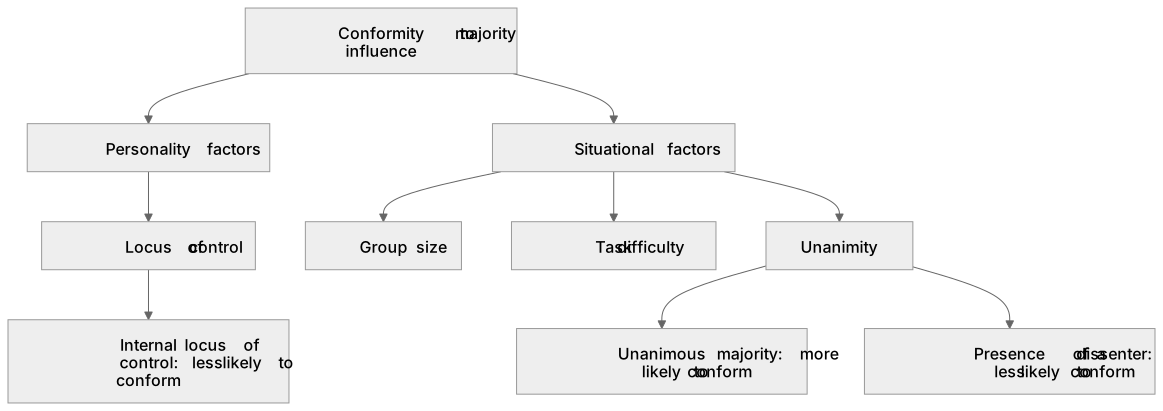
Label the diagram
Some boxes have lost their names. Pick the right name for each number.
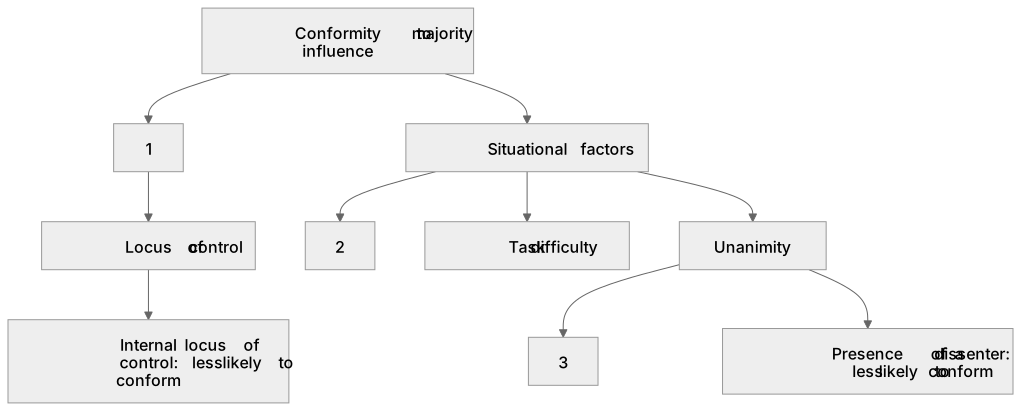
1Box 1
2Box 2
3Box 3
There is more to this lesson
The full lesson goes on to check your understanding and help you earn the marks. Create a free account to carry on, with your progress saved.
A week of Premium from your first lesson · Then the free plan continues · No card, no charge
Test your understanding of Social influence: 5.1.3 Understand conformity to majority influence and factors affecting conformity to majority influence, including: a. personality b. the situation
Active recall beats re-reading. Take an instant quiz now to test what you’ve learned and lock it into long-term memory.
A week of Premium from your first lesson · Then the free plan continues · No card, no charge